Two opposition members tell the Guardian how Eritreans are becoming increasingly disillusioned with the repressive regime
The Guardian — Eritrea is the most closed and repressive country in Africa, routinely denying access to the international media. No foreign journalists are based in the country and there is no independent local press. However, in a rare and courageous breach of the wall of silence, members of the internal opposition spoke to the Guardian and Radio France International last weekend.
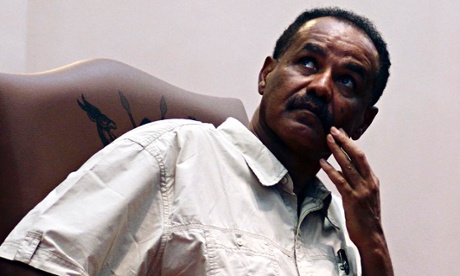
Since independence from Ethiopia in 1993 Eritrea has been ruled by as a one-party state by President Isaias Afewerki, who brooks no opposition.
Two members of the Eritrean resistance, speaking via a secure connection, described conditions inside the country. “Essentials like water, electricity or petrol have disappeared,” they said. Food is so expensive that even middle-class families find it difficult to find enough to eat.
They said tension in the capital, Asmara, is high, with reports of trucks filled with Ethiopian “mercenaries” – from the Tigray People’s Democratic Movement (TPDM), known locally as Demhit, which Eritrea supports – ringing the city. The last round of compulsory military service failed, with only around 50 of the expected 400 conscripts reporting for duty. “We think it is highly likely that Demhit will carry out a door to door sweep to round up recruits,” said Sami (not his real name).
The TPDM, drawn from the ethnic group that now rules Ethiopia, has been given sanctuary, arms and training by Afewerki. Eritrea and Ethiopia have a long-standing border dispute, which has resulted in tens of thousands of troops confronting one another in the bleak, mountainous border region. Supporting Demhit is Eritrea’s means of maintaining pressure on the Ethiopian government.
A UN report published this month estimated that some 20,000 TPDM fighters are based in Eritrea, bolstering the president’s security. The report described them as having “a dual function as an Ethiopian armed opposition group and a protector of the Afewerki regime. Its fighters, who are from the same ethnic group as Afewerki, are seen to be personally loyal to him, unlike the defence forces whose loyalties have been questioned by the president in recent years.”
Since a failed army mutiny against the Eritrean regime in January 2013, the TPDM has become central to Afewerki’s survival. This reliance on foreign forces is deeply resented by the Eritrean population. “They demanded the identity documents of a friend of mine and I,” Sami said. “When this happened earlier this year there was a riot. People really hate them.”
Despite the intense security, the resistance is finding new ways of getting its message across. The group, which began over two years ago,started by helping organise phone calls from the diaspora abroad to Eritreans back home.
The resistance told the Guardian how it evaded tight security to put up posters protesting against conscription. “We lay on the streets, pretending to be homeless people,” said Sami. “It was freezing cold, but the security officials walked right over us. When they had gone we could put up our posters.
A smuggled video of “Freedom Friday”, now on YouTube, shows people in Asmara crowding round to read the posters.
Sami described the growing contempt for the regime. “In coffee bars you hear people talking – even high-ranking officials complain openly about the regime.” The government led the struggle for Eritrean independence, and for years relied on its legitimacy to demand the population’s support. “The movement was treated like a religion then, like the Bible or the Koran, and followed unquestioningly,” said Sami’s colleague, Temasgen. “Slowly, this has fallen away – and now it is gone.”
Both men know the risk they are taking in speaking to the international media. “I am willing to pay with my life,” Sami declared. “In history I would rather be remembered as someone who made the ultimate sacrifice rather than just sit and complain to my neighbours.”
They appealed for international pressure to be maintained on Afewerki: “Listen to our agony. We thank you for giving shelter to Eritrean refugees abroad, but if you are a decision-maker we beg you to keep up the pressure on the Eritrean regime.”
The opposition’s growing confidence and the fragility of the regime comes at a time when discussions are taking place about relaxing the sanctions against the Eritrean government. There are suggestions that the European Union is thinking about a new approach towards Asmara, and offering aid worth €200m (£158m) as a carrot for improved human rights.
Previous attempts by the former EU development commissioner Louis Michel to negotiate the release of the Swedish journalist Dawit Isaak in return for aid resulted in empty promises. Neither Dawit nor other political prisoners were freed. Instead, repression intensified, resulting in an exodus of refugees, who find their way across the Sahara and the Mediterranean to arrive at Calais in their hundreds.
